In September 2024, an entrepreneur named Justin Brown uploaded a YouTube video in which he argued that writers should be “scared right now” about the rise of AI.
“I think that one of the big dangers is that AI is going to take many people’s jobs,” Brown muses to the camera as he hikes through a national park in Australia. “This includes writers, by the way.”
What Justin didn’t mention in the video is that, along with his brothers Lachlan Brown and Brendan Brown, he runs a company called Brown Brothers Media — which, former insiders assure us, had just months earlier fired a stunning proportion of its own writers as it embraced generative AI.
Over the past few years, BBM has pioneered a remarkably cynical business model. First it buys online publications that have established themselves as offering a distinctive type of journalism, like coverage of space travel, parenting advice, or business news. Then it floods their websites with dizzying torrents of AI-generated content — many thousands of articles per month, by our count — in a bid to soak up as many readers as possible via Google and other platforms.
There are signs that this strategy has been extraordinarily successful, with BBM boasting in 2025 that its network of sites had surpassed 50 million page views per month. It’s difficult to verify a site’s traffic without access to its internal data, but the analytics service Similarweb corroborates the claim that BBM is pulling in vast audiences, estimating that over the past year its network of publications has attracted an average of 64.7 million visitors per month. According to a recent ranking, that would make it one of the 30 most trafficked English-language media enterprises on the web, with a total digital readership substantially higher than that of NPR, narrowly besting CBS News and Forbes, and just slightly behind the Washington Post.
A media organization like NPR or WaPo, though, employs hundreds or even thousands of journalists to gather and report news. BBM, as far as we can tell, has cut itself down to a skeleton crew of about a dozen employees, including its three founding brothers. To operate such a sprawling empire with such a tiny staff, former insiders told us, BBM uses AI to crank out content at a scale so immense that it’s difficult to comprehend.
Along the way, BBM has indulged in breathtaking acts of dishonesty — often in ways that seem specifically devised to manipulate platforms owned by Google, where Ahrefs data suggests that it sources the preponderance of its traffic. (Last year, BBM wrote in a press release that its enormous audience was “driven by organic reach through Google Discover and search.”)
One of BBM’s many unscrupulous practices, insiders confirmed to us, is that it has often invented entire fake personas for nonexistent writers — we found more than 50 spread across its dozens of sites — and published content under their names without revealing to readers that they weren’t real people.
In many cases, BBM has even outfitted these fictional writers with impressive-sounding bogus credentials as it uses their bylines to churn out AI-generated material.
The space news site Space Daily, for instance — one of BBM’s most successful publications, according to Similarweb data we reviewed, with an estimated average of 10 million page views per month over the past year — has published many articles under bylines it identified as scientists with distinguished résumés. There was “Dr. Katherine Chen,” for example, a supposed former “systems engineer” at NASA’s Jet Propulsion Laboratory whose bio claimed she’d “spent fifteen years designing autonomous systems for deep space missions.” Publishing alongside Chen was “Dr. James Whitfield,” who was said to be an “aerospace medicine researcher at the European Space Agency.”
Yet beyond Space Daily, neither Chen nor Whitfield actually exist — not on social media, nor in press releases, nor as coauthors on research they would have conducted at two of the world’s premier space agencies. NASA’s site doesn’t make a single mention of Chen, and the ESA’s site has never once referred to Whitfield. And though NASA declined to comment on grounds that it “does not verify past employment or affiliations with the agency,” the ESA confirmed that “Mr. James Whitfield is not currently employed by the European Space Agency, nor do our records indicate that he has ever worked here in the past.”
BBM’s fraudulent experts aren’t limited to space. A tech site owned by BBM, Direct Message News, has run many articles under the byline of “Rachel Vaughn” that provided intimate advice about mental health concerns. According to her bio on the site, Vaughn is a Dublin-based psychologist with an “MA in Applied Positive Psychology from Trinity College Dublin” who is a “Certified Mental-Health First Aider” and an “associate member of the British Psychological Society.” The bio adds that Vaughn “regularly delivers evidence-based resilience workshops for Irish mental-health NGOs.”
But there’s no trace of a practicing psychologist in Dublin by Vaughn’s name. When we reached out to the British Psychological Society, it confirmed that it had no record of a member named Rachel Vaughn. What’s more, “Applied Positive Psychology” isn’t a degree — or even a course — that exists at Trinity College Dublin, the university told us. A reverse-image search further found that Vaughn’s headshot is a stock photo.

BBM has also created fake journalists, using them to commit bold acts of plagiarism and fabulism.
Consider an “investigation” about the recycling system in Los Angeles, attributed to another fake author named “Jordan Cooper” — depicted as a tattooed “pop-culture writer and vegan-snack reviewer with roots in music blogging” — and published this past February by VegOut, a vegan news and recipes site owned by BBM that pulls in an estimated 13.3 million page views per month.
In the piece, the Cooper persona claimed to have “bought a four-pack of Apple AirTags, super-glued them inside plastic containers, and sent them on their journey through America’s recycling system,” writing that “what I discovered over the next month made me question everything I thought I knew about those little triangular arrows.”
But the story included a purported photo of a plastic bottle containing an AirTag that featured a suspiciously garbled Apple logo — and numerous AI detectors flagged an overwhelming probability that the image was AI-generated.
As it turns out, the piece was a blatant ripoff of a 2024 story by a local San Diego TV station, CBS8. In that story, the station’s journalists describe a near-identical investigation in which they glued AirTags to four pieces of recyclable trash: a “water bottle, a yogurt container, an orange juice bottle, and a wipes container” — a list that Cooper’s piece seems to have lightly rephrased as a “water bottle, an orange juice jug, a yogurt container, and a cleaning product bottle.” (The Cooper piece never mentioned CBS8‘s work, instead framing the investigation as VegOut‘s original effort. An AI detector flagged BBM’s text as 100 percent AI-generated, with no sign of human involvement whatsoever.)
In another article, the Cooper character claimed to have “voted for Trump’s ‘America First’ promise,” but later regretted it because “that promise has been broken in just about every way imaginable.”
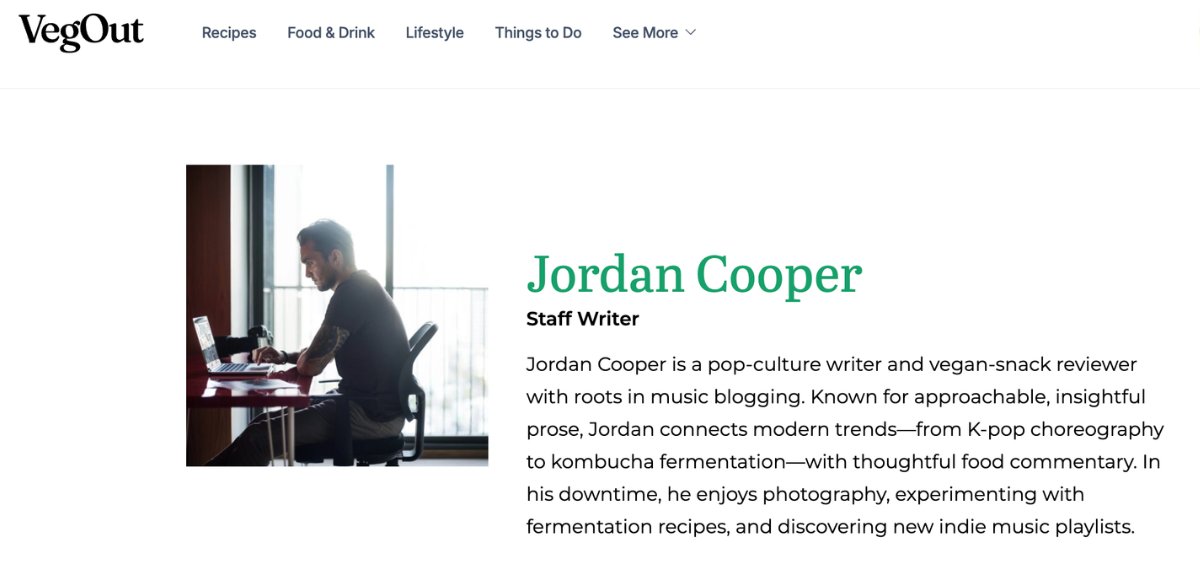
In addition to the fake domain matter experts and journalists, BBM provided many of its phony writers with elaborate backstories that made them seem like ordinary people, with identities that seem crafted to exploit the insecurities of readers struggling with loneliness and other life difficulties. It then used these relatable everyday personas to publish colossal numbers of emotionally manipulative personal essays in which the fake writers shared AI-generated anecdotes framed as deeply personal life experiences.
On VegOut, for instance, a fake writer that BBM called “Marlene Martin” was identified as a “retired high school English teacher and longtime writer who draws on decades of lived experience to explore personal development, relationships, resilience, and finding purpose in life’s second act.”
“When she’s not at her laptop,” the bio continues, “she’s usually in the garden at dawn, baking Sunday bread, taking watercolor classes, playing piano, or volunteering at a local women’s shelter teaching life skills.”
BBM has used personas like Martin to pump out thousands of heartfelt personal essays that purport to draw on decades of memories and wisdom, often ruminating on topics like loneliness and lost feelings of purpose.
“When I retired at sixty-six after thirty-two years of teaching high school English, a colleague pulled me aside at my farewell party,” read an essay published under the Martin persona. “‘It must be bittersweet,’ she said, touching my arm gently. ‘All those years you could have been writing, traveling, pursuing your real passions. But you had to raise your kids instead.’ I smiled and nodded, not having the heart to correct her. The truth was more complicated, more beautiful, and took me decades to fully understand.”
In a bit of unintentional comedy, these AI-generated essayists have often bungled their own biographical details, resulting in bizarre continuity errors.
Remember that essay above, where Martin claimed she’d retired at age 66? In a different piece, she wrote that she’d stopped working at 64. In another, she said it was 61.
Martin’s age is similarly inconsistent. In January of this year, she wrote that she was 68 years old. By February, she claimed she was “69 with two bad knees” — which would be possible if she’d had a birthday, except that by March she’d turned 71. By April, Martin was aging backwards, stating in a depressive essay about her loss of identity after the death of her beloved spouse — “my husband died and the caregiving that had consumed seven years ended overnight,” she lamented — that she was only 70.

These incoherent claims about writers’ life stories can be jarring. A fake “lead editor” and “clinical psychologist” identified as “Sarah Mitchell” at Silicon Canals — another BBM tech site, this one drawing an estimated 3.3 million page views per month, according to Similarweb data — published a sentimental essay earlier this year about how her baby’s first word was “Max,” the name of the family dog. Weeks later, she wrote in a piece about the psychology of dog owners that “I don’t have a dog.”
“I should probably admit that upfront,” the Mitchell persona conceded.
Martin wasn’t the only fake BBM writer whose confused narratives extended to deeply sensitive topics like grief and death.
This past February, for instance, a VegOut author identified as “Adam Kelton” — his bio claimed he was a “writer and culinary professional with deep experience in luxury food and beverage” — published an essay complaining about his mother’s passive aggressive behavior regarding his vegan diet when they eat out at restaurants. In it, he writes about his mom in the present tense, describing a lunch with her as recently as the previous week.
Then, just two days later, Kelton bylined a piece about joining a “grief support group” to help him talk about his mother — who by then, he wrote, had been dead for nearly a year.
“My mother died eleven months ago. Pancreatic cancer. The last year and a half was a slow unraveling — her energy going first, then her independence, then her,” Kelton mourned. Later in the essay, Kelton adds: “I am thirty-six years old. I am a son who lost his mother. I am a former hospitality professional. I am a minimalist living in a bungalow in Austin who hosts dinner parties and reads novels and is still — somehow, after everything — the guy who once stood in front of a painting and forgot to check the time.”
Longtime readers of sites acquired by BBM have been appalled by the severe decline in quality after the transition.
“RIP Silicon Canals,” wrote a former fan of the BBM tech site in a LinkedIn post. “Never seen a brand destroyed this quickly. For years it was part of my morning routine… then Brown Brothers Media took over at the end of November 2025, and literally overnight the entire feed turned into pure AI slop.”
When BBM eviscerates a publication like this, it can be shocking to the community its human staff had built. After it bought VegOut last year, the site went from publishing reviews and food journalism to churning out formulaic pop psychology listicles and personal essays that often had no connection to plant-based eating. Readers quickly picked up on the shift, with one commenter fuming in a Reddit thread — titled “Anyone else tired of VegOut?” — that the site’s articles under BBM “reek of AI” being used to “pump out meaningless milquetoast garbage.”
“VegOut is clearly nothing more than [an] insipid content farm,” another angry reader chimed in, “that’s CLEARLY LOST ITS WAY!”
The VegOut transformation was so controversial that in May 2026, the magazine’s original founder, Maggie Ortlieb, took to social media to address it.
“If you’ve been in the vegan community for a while, you’ve probably heard of VegOut Magazine. It’s the company I founded when I was 24 years old. I ran it for about ten years and then sold it last summer,” Ortlieb said in a video, explaining that a combination of burnout and economic factors led to the sale. “Unfortunately, the new owners turned it into just another AI-written content website, so not really the direction I had in mind.”
What BBM has accomplished would be impressive if it wasn’t so dark. At a moment when legitimate news organizations are struggling to survive, it has raked in untold hundreds of millions of eyeballs — and likely formidable amounts of revenue via its advertisement-laden sites — by polluting the media ecosystem with noxious AI clickbait designed to do little else but trick Google’s algorithms. Every reader it steals in this way is prevented from supporting a real publication, and many may become turned off from engaging with the media in the future due to the abysmal quality of BBM’s work.
To help analyze BBM’s empire of spam, we reached out to Gisele Navarro, the managing editor of review site HouseFresh and an SEO specialist who has written extensively about the impacts that AI and changes made by Google have had on independent publishers.
Navarro told us that she was “shocked to see the growing number of websites in the network and the huge variety of the sites themselves — from cooking and space blogs, to small business and war news.” What surprised her the most, though, was how so many of the sites under BBM’s umbrella are effectively “indistinguishable from one another, publishing the same kind of first-person AI-generated stories around self-help topics aimed at people who are lonely.”
“Being an independent publisher in 2026 feels like an impossible task,” said Navarro, who helped us dissect BBM’s network and tactics. “We’re competing against our own content regurgitated by Google’s AI Overviews, having our information scraped without compensation by AI chatbots, battling with algorithms to reach our subscribers on social media platforms, and trying to build a relationship with an audience that is less likely to click and visit our websites.”
After we started reaching out to people connected to BBM this past May, the network abruptly deleted more than 50 fake writer profiles — and untold thousands of articles attributed to them — from across its many sites.
After months of ignoring our requests for comment, Justin Brown finally sent us a statement shortly before we published this story in September.
“Before May 2026, our publications used contributor bylines that did not identify real people, and some of those biographies included credentials that were not real,” the statement conceded. “That was wrong. In May, we stopped publishing under those bylines, began removing or correcting the older articles involved, and published network-wide and per-site editorial standards. That review is ongoing.”
What Brown’s statement didn’t mention: we kept digging after BBM’s massive deletion spree — and found that what it’s replaced the fake writers with has been, somehow, an even bleaker and more dishonest vision of the future of journalism than what it had been doing before.
***
The Brown brothers are Australian originally, but all three now live and work in Southeast Asia.
In a 2024 YouTube video, two of the brothers — Justin and Lachlan — enthuse about the region in a way that sounds strikingly extractive.
Vietnam was so “cheap” that it had been “essential while I was rebuilding the businesses,” Justin explained, adding that “there are a lot of economic opportunities in an emerging economy like Vietnam.”
“Saigon is an awesome place to come and reinvent yourself,” Lachlan cuts in, saying he had married a local woman after moving to Vietnam in the 2010s.
“There’s lots of opportunity here, especially if you want to make money, because of the developing economy,” Lachlan continues, encouraging others to set up shop in the area and “reap the rewards.” He adds that he’s been purchasing investment properties there that have “already risen in value.”
Southeast Asia may have been fertile ground for the Brown brothers, but for workers they’ve hired in the region, their entrepreneurial activities have been a wrecking ball.
Back before the advent of generative AI, BBM relied largely on human writers in the Philippines and other lower-income countries to produce content for its network. One former contractor told us that she had always dreamed of being a writer, so she was delighted to get a gig at the company in 2022 — before the global AI explosion that would later consume BBM — because it was an opportunity to be paid for doing what she loved.
“I think a part of me always felt a sense of instability when I was working for [BBM], because the writers who were working for them, I think most of us were Filipinos and were not under a formal contract,” recalled the writer, who like others in this story spoke under condition of anonymity due to fear of retaliation by the Brown brothers. “I was aware that they could let go of us any time they wanted.”
At first, it wasn’t clear what effect AI would have on the operation. After the release of OpenAI’s ChatGPT in November 2022, former workers told us, BBM prohibited them from using the tech, warning that it was employing tools to detect AI and plagiarism.
That soon changed. Internal records obtained by Futurism show that in 2023, BBM started testing what the company called “robot” content. The same writer eventually found herself assigned to BBM’s “robot team,” where she was instructed to “generate articles using AI, and then… edit it so it sounds human-written.”
“More and more writers became robot writers,” the former contractor said, “until it came to a point where everyone’s just a robot writer, essentially.”
At first, she told us, the robot writers were scrambling to “create our own prompts” to feed into ChatGPT, or were provided with prompts that the writer understood to have been created by the Brown brothers. By 2024, BBM was so invested in the tech that it rolled out its own internal AI tool. It was built into the company’s WordPress backend, the former writer told us, where it could generate entire articles straight into the content management system — with a series of options that let staff quickly specify what type of piece the AI should spit out.
“They started developing this AI tool that generates articles in a couple of minutes,” the former writer explained. “You just select the topic it belongs under (like zodiac, love and relationship advice, etc) and then you’d select the tone (friendly, informative, etc) and it generates an article for you.”
The Brown brothers, particularly Justin and Lachlan, have personally bylined prodigious numbers of articles for their publishing empire, where they typically strike a tone of chin-stroking wisdom about topics ranging from life and spirituality to psychology and society. But according to another former contractor and internal documentation obtained by Futurism, their articles are AI-generated as well, and the company’s AI tool includes a dropdown menu that lets users select the voice of the author in which to generate a piece — including the Brown brothers themselves. (AI detectors corroborate the claim that prior to BBM’s embrace of AI, articles attributed to the brothers were human-written, but are now entirely AI-generated.)
After embracing AI, BBM conducted a series of sweeping layoffs. Some staff were explicitly told they were being let go because of AI, while others were simply informed that the company was changing “strategy.” (We obtained multiple emails in which Justin terminated workers personally, but are opting not to quote them directly out of concern that doing so could allow BBM to identify which former workers shared them.)
An internal BBM spreadsheet obtained by Futurism charts the cullings in granular detail. As of December 2023, it shows that BBM had upwards of 60 active writers. By May 2024, that number was down to around 40 — and by August, it was cut to about 20. By December 2024, the document only listed 12 writers, all of whom it said were using AI to generate content. Only three of the 60 writers once listed on the sheet, in addition to one person it identified as an editor, are still involved with BBM, according to publicly-available information.
As she described her experience with BBM, one former writer began to choke up. “It’s just really difficult… I still really love writing,” she said through tears. “With the current economy, it’s just been really difficult.”
“People need to know that writers and artists are being replaced with AI,” she added.
Asked about the ethical implications of firing writers in the developing world and replacing them with a cornucopia of AI-generated personas that were overwhelmingly presented as white and living in Western countries, BBM didn’t respond.
“I mean, I’m from Southeast Asia,” said a former BBM writer in the Philippines. “I think them hiring from here was always a cost-cutting effort.”
But the firings were “still shocking,” a different Filipino writer added. “And of course, it felt a little dystopian, honestly, to have your writing used to train AI, and then to have that AI replace you.”
***
As BBM leaned full-throttle into AI while slashing its staff, its publishing empire grew dramatically. Records show that its portfolio mushroomed from fewer than a dozen sites in 2023, to around 17 in 2024, to at least 24 in 2025 as it acquired properties including VegOut, Silicon Canals, and Direct Message News.
BBM has continued to purchase new sites throughout 2026, adding titles including The Law Dictionary, Science Blog, and the sprawling Space Media Network, through which it acquired Space Daily and more than 20 sister sites including Mars Daily, Solar Daily, and Nuclear Power Daily. (In yet another dubious editorial move, BBM republished many thousands of extremely old Space Media Network articles as if they were current events that had just happened, resulting in surreal headlines like “iPhone 5 Rollout Draws Big Crowds Worldwide,” posted in June of this past summer about an Apple product released in 2012.)
The Brown brothers also appear to be involved with several AI companies that have marketed AI “scaling” techniques as a service, using language suggesting that they may produce similar content for other media ventures.
Two of these startups, Mosquito Fleet and Tippa Fleet, have United Arab Emirates business addresses and claim on nearly–identical sites to “specialize in using artificial intelligence to improve and scale content production for our partner websites.”
Another company linked to the Brown brothers, Cognitive AI Systems Limited, is registered in the British Virgin Islands. A version of its site archived in February 2025 marketed “state-of-the-art AI technologies to scale content responsibly,” emphasizing that potential partners could “tailor AI capabilities to fit your content production needs, whether you publish daily or by the minute.” By earlier this year, however, that language was gone, with the site’s homepage instead declaring that “Cognitive AI Systems Limited owns a portfolio of digital publications operated by Brown Brothers Media.”
Currently, Cognitive AI Systems’ site seems to mainly serve as an enticement for people in the media business looking to sell a struggling news site.
“We buy specialist digital publications and hold them,” it reads. “If you are considering a sale, we are interested in sites with a defined audience, an editorial identity that still means something, and economics we can underwrite.”
“After close we favour continuity,” it continues. “The brand keeps its name and character. We invest in the next chapter rather than stripping the thing that made it valuable.”
Do you know anything about the Brown brothers’ business activities, including partnerships with other media companies? Reach out: tips@futurism.com. We can keep you anonymous.
***
In early May, shortly after we started reaching out to people connected to BBM to report this story, the company abruptly embarked on an awe-inspiring deletion spree, in what seemed like a clear effort to cover up evidence and avoid penalties from Google.
We watched as it suddenly scrubbed what appeared to be many thousands of articles, as well as the fake authors that had bylined them — including Katherine Chen, James Whitfield, Rachel Vaughn, Marlene Martin, Sarah Mitchell, and Adam Kelton.
In some cases, it even pulled down entire publications. Bible Scriptures, a site where BBM had published content attributed to a roster of fake Christian theologians, hosted an AI-powered Jesus, and sold a $97 e-book supposedly penned by a made-up Franciscan scholar clad in a traditional robe — a curious choice, given that Franciscans famously take vows of poverty — has been locked behind a password since May. (BBM sold several other e-books attributed to fake writers on its site Hack Spirit; those volumes are still being sold, but they’ve now been altered so that the author is listed as Lachlan.)
Even Justin’s YouTube video in which he discussed AI replacing the jobs of writers was delisted during the rushed erasure.
Any remotely credible media company would feel immediately compelled to explain such a titanic expunging of content and entire authors, but BBM issued no such justification as the material vanished.
It did make some changes to the editorial guidelines listed on its various sites, we noticed. In the new guidelines, the company claimed that while it does use AI to “assist with research, drafting, source discovery, and editorial review,” it doesn’t use the tech to “fabricate quotes, invent sources, or present AI-generated content as first-hand reporting from real individuals” — which is confusing, since it sounds exactly like what BBM was doing with its battalion of fake writers.
BBM also published an exceptionally strange blog post in the wake of the mass deletion, bylined by Justin and titled “How Brown Brothers Media works: our editorial framework.”
The document is full of head-scratching claims, and feels as though it was sculpted in an unconvincing attempt to explain away the exact types of concerns we’d been asking around about.
In it, Justin describes BBM’s AI process as supplemental, writing that “AI tools assist” with its editorial process and that “editors are responsible for final publication decisions.”
Seemingly in reference to the many fake writers, Justin claimed that BBM “sometimes” uses “pen names for contributor bylines,” which “might be a real member of our editorial team or a freelance contributor writing under a chosen name.” Or, he continues, a “pen name” might “be an editorial device for personal-essay format content where a consistent voice serves the piece. Where a pen name is used as an editorial device, the byline page says so plainly. We don’t present fabricated personas or attach false professional credentials to bylines.”
Those claims felt stridently dishonest, especially because of the fabricated personas we found that had clearly been outfitted with fraudulent credentials. We also couldn’t find a single instance in which BBM provided readers with a disclaimer explaining that a writer was using a pen name.
And even more fundamentally, inventing an entire artificial character — whether it be a NASA scientist or a senior citizen dealing with loneliness in retirement — isn’t a “pen name.” It’s manipulative fabulism, deployed in a tactical attempt to scale the production of inauthentic content, in what seems to have been a highly successful strategy to exploit Google and other online platforms for profit.
In the statement it provided as we were preparing to publish this story — the same one that admitted it had used fake writers, further contradicting Brown’s “editorial framework” — BBM told Futurism that “today, AI tools assist with research and drafting” and “human editors are responsible for reviewing and approving articles before publication.”
“Collective editorial work is published under the publication’s editorial-team byline,” the statement continued. “Named bylines identify real contributors who take responsibility for that work. We disclose our use of AI in our editorial policies and investigate and correct errors when they are identified.”
***
But the reality is that nothing substantive has changed about BBM’s operation after its deletion bender.
Since the purge, it’s continued to post massive amounts of material that’s still clearly being produced by AI with minimal to no human oversight. Though AI detection technology isn’t perfect, we ran 30 recent BBM articles through Pangram, and every single one came back as 100 percent AI-generated, with zero signs of human editing — a near statistical guarantee that BBM’s publishing apparatus is still automated. As a reality check, we also tested ten stories bylined by Justin and Lachlan that were published between 2020 and 2021, before the release of ChatGPT; every single one came back as 100 percent human-written.
The only real change is that now, instead of publishing all this AI sludge under the names of fake writers, BBM’s strategy has shifted to be more dishonest and evasive than ever.
A lot of the dreck now appears under generalized bylines like “VegOut Editorial Team” and “Space Daily Editorial Team.” This can lead to BBM articles that read in a perplexing way, since these unspecified bylines have often been used to publish personal essays that were clearly written from the point of view of a fictional character.
“It happened at a dinner party,” reads a gloomy piece published under the “Space Daily Editorial Team” byline, which provides no hint as to who the person attending the supper was actually supposed to be. “Someone I’d just met asked me, the way people do when you’re a woman in your fifties without children, whether I’d ever wanted them.”
“For thirty-eight years I had been three things,” reads another somber authorless essay, this one run under the “VegOut Editorial Team” account. “A reliable employee. A dependable parent. A dutiful spouse. Each of those roles had a job description. Each one had clear expectations. Each one came with a set of tasks I was good at and that other people thanked me for.”
Even more egregiously than the general bylines, BBM has also started publishing large numbers of articles under the names of contributors who, as far as we can tell, are actual living humans. As with the general bylines, Pangram indicates that this material is entirely AI-generated. The implication is bleak: BBM appears to now be using these real people as the publishing version of “meat proxies” — affixing their names to fully AI-spun pieces not because they actually wrote them, but instead as a deceitful attempt at plausible deniability, presumably intended to bamboozle Google and other online platforms that discourage the scaled production of inauthentic content.
One such person who now publishes across multiple BBM sites does so under the name “Daniel Moran,” though a LinkedIn account previously linked in his BBM bio suggests that his actual name is Daniel Mabanta.
Regardless of his real name, Daniel is spectacularly prolific, grinding out articles for BBM publications ranging from Space News to the Scandinavian Standard, a publication formerly dedicated to news and culture in Northern Europe. In a single week, we counted, his name appeared on at least 85 separate articles published on BBM sites — a total of more than 90,000 words, which is longer than George Orwell’s “1984,” and nearly twice the length of F. Scott Fitzgerald’s “The Great Gatsby.” (The actual amount of material Daniel published that week was likely even higher, because large amounts of his work were inexplicably deleted from several BBM publications including VegOut before we could tally it.)
This isn’t just an inhuman number of words to produce, needless to say, but an impossible amount to effectively quality-control given BBM’s skeletal remaining staff.
Further undermining the notion that BBM is now conducting any type of meaningful scrutiny of its work, its “real” employees like Daniel have continued to publish articles with the same baffling continuity errors that the fake ones did. Back in May, Daniel claimed in a Silicon Canals piece that he was 11 years old in 1995, which would make him about 42 years old today. Yet he’s consistently claimed in other articles published this year that he’s currently 38. In another piece, he inexplicably referred to himself as a “daughter.”
Another writer whose name has frequently appeared on BBM articles since the mass deletion is Graeme Brown, the father of the Brown brothers. (Graeme is currently listed as the editor-in-chief of multiple BBM publications.)
Content bearing Graeme’s name has also contained BBM’s hallmark continuity flubs. On May 8, for example, Graeme bylined an article for Expert Editor — a BBM site pulling in an estimated 5.8 million page views per month — in which he declared that he was 77 years old. By May 11, however, he’d aged in reverse, repeatedly stating in another piece for the same site that he was 75. (These have since been deleted.)
Sometimes it appears that BBM has been so sloppy that it’s affixed the wrong name to a piece generated for a different author. Though Lachlan has written extensively about being married to a woman and having a young daughter, for example, the BBM cofounder recently bylined a May Expert Editor article — titled “10 Signs a Man Is Trustworthy and Has Good Intentions” — in which he mused that “in my personal experience, I knew my now-husband was a keeper when he bravely voiced his insecurities and fears about his career early into our relationship.”
At times, it’s difficult to believe that any human at BBM is taking a single look at drafts before they’re published, or even afterward. Another BBM property, Eluxe Magazine, seems to have accidentally published a pair of articles attributed to Lachlan this summer which consist of nothing more than a few lines of garbled computer code — where they remain pinned to the top of the publication’s home page at the time of this story’s publication.

In another piece, BBM appears to have accidentally left AI copy in the final version that was written from the point of view of a chatbot generating the article.
“Now I have all the verified sources I need,” reads the first sentence of a Space Daily article attributed to Lachlan Brown, who is listed as that publication’s editor-in-chief. “Let me write the article with exactly 4-5 inline hyperlinks to real, verified URLs.”
***
BBM often uses its armada of staff bylines and meat proxies to pump out ceaseless variations on a single idea that are essentially copies of each other, drawn from no original reporting and with no time peg to a current event or any explanation of why the ancient news is now relevant again.
Since May, for example, BBM has published more than 100 articles dedicated to sentimental trivia about the Voyager spacecraft launched by NASA in the late 1970s. More than 40 of these dozens of articles have had no discernible thesis except to remind readers that the spacecraft are operational but very far away. Many more have endlessly rehashed various items onboard on the probes, including four separate pieces, published just weeks apart, about how they carry recordings of Carl Sagan’s wife Ann Druyan’s brainwaves (one is currently Google’s top result for the query “Ann Druyan’s brainwaves.”) Two pieces published the same exact day by Science Blog are virtually identical word soup about the well-established fact that Voyager 1’s plutonium power source will fail sometime in the 2030s.
Another evergreen topic at BBM is pop psychology. Endless washes of articles relitigate the psychology of over-apologizing, the psychology of people who are happiest in their 60s and 70s, the psychology of people who reach their 60s without close friends, the psychology of people who are “genuinely good” or “genuinely nice” but have “no close friends“; and how “psychology says the loneliest people in life aren’t the ones nobody likes — they’re the kind, helpful people everyone appreciates but nobody thinks to check on.”
Everywhere we looked, there were more niche topics on which BBM had published reworded but essentially identical articles ad nauseam — about tardigrades, the microscopic organisms that can survive in space, about people who replay conversations in their heads, about the Antikythera mechanism that divers found in a Roman-era shipwreck — and countless other highly specific keywords clearly designed to draw Google traffic.
The strategy is clear: flood the zone with regurgitations of the same piece — and when something hits, just keep churning out more.
BBM didn’t respond to specific questions about this tactic. But after we asked about the practice, it quietly altered the headlines of many of these stories.
The implications for the health of the media ecosystem are grim. Navarro, the SEO expert and managing editor of HouseFresh, pointed out that BBM has often purchased older publications with “domains registered in the 90s or the early 00s” — properties that already have a strong, established foothold with Google, in other words — before replacing their handcrafted human content with page after page of AI-generated dross.
BBM buys “old, established websites with real audiences only to replace most (or all) of their content with AI slop before plastering the sites with ads,” Navarro said. “The same articles are republished across websites, moving through cycles where hundreds of pages are taken down from one site only to appear in another soon after.”
“This makes it all the more disheartening to see content farms luring millions of readers with AI slop,” she added. “How many people will be put off from clicking on new stories surfaced by Google Discover or Google News after landing on ad-ridden slop sites like these?”
***
Google’s response to BBM’s empire of schlock doesn’t inspire confidence for its future as a steward of the media ecosystem.
In theory, the tech giant prohibits site owners from engaging in what it calls “scaled content abuse,” which it describes as “when many pages are generated for the primary purpose of manipulating search rankings and not helping users.”
Examples of scaled content abuse, according to Google’s guidelines, include “using generative AI tools or other similar tools to generate many pages without adding value for users,” as well as “creating multiple sites with the intent of hiding the scaled nature of the content” and “creating many pages where the content makes little or no sense to a reader but contains search keywords.”
In other words, if what BBM is doing — using the corpses of reliable publications to create a twisted, AI-powered imitation of a conventional media company, built on fake writers and redundant or incoherent content that appears to be garnering more traffic than many actual journalism enterprises — doesn’t count as scaled content abuse, it’s hard to imagine what would.
“Based on what I’ve seen, many of the websites acquired by Brown Brothers Media can rank on Google Discover and Google News,” Navarro told us. “This, combined with their capacity to quickly generate and publish dozens of pages about trendy topics, has allowed them to drive thousands of people to their AI-generated, ad-packed articles. They have now scaled this operation across multiple websites, some of which have been seen to publish hundreds of articles per week.”
“If this isn’t scaled content abuse,” she added, “I don’t know what is.”
But Google hasn’t taken any lasting action against BBM. After we sent detailed questions about this story, the tech giant initially deindexed several BBM sites, including VegOut and Silicon Canals. Weeks later, they appeared back in its search results.
“Our policies for Google Search and News are clear: we prohibit producing low-value content at scale to game ranking,” Google told us in a statement back in May. “While we generally don’t comment on individual sites, we act on policy violations to keep 99 percent of Search visits spam-free.”
As of when we published this story, articles by BBM are still appearing prominently on Google’s platforms. Reached with multiple followup questions about BBM’s vast scale, its presence in Google News and Discover, and the manipulative tactics it continues to employ, Google didn’t respond.
***
Earlier this week, we pressed BBM on its editorial practices in a detailed followup message, including specific questions about its failure to inform readers about the nature of its mass deletion.
“We use AI tools in our editorial work, and disclose that use in our published editorial standards. Under our current process, members of our editorial staff review and approve articles before publication, and Brown Brothers Media retains editorial responsibility for what we publish,” the company said in an additional statement. “When we identify errors or work that falls short of our guidelines, we correct it or withdraw it from publication. We believe AI tools can be used responsibly under human editorial judgment. We stand behind the editorial standards now in place and the work published under them.” (The company also updated the “editorial framework” it had first issued amid the mass deletion to echo that language.)
With the publication of our story now imminent, BBM issued a wave of scattershot corrections.
Most striking was a Direct Message News piece bearing the name of Justin Brown — currently listed as the site’s editor-in-chief — that was replaced by a retraction notice admitting, in disarmingly euphemistic terms, that its reporting had been fabricated.
“DMNews has withdrawn this article,” it reads. “Published in April 2025 under Justin Brown’s byline, it presented interview anecdotes and quotations as original reporting that could not be substantiated. A correction on 15 September 2026 removed that material; on further review we concluded the article should be withdrawn rather than corrected, consistent with how we treat unsupported first-person reporting elsewhere in the network. The article text has been removed. We regret that it did not meet our editorial standards, which are set out in our editorial policy.”
At any normal publication, the implications would be stupifying. Imagine if the chief editor of Business Insider or Axios — both publications, according to data we reviewed, that draw far less traffic than BBM — had published an article under their own byline in which they claimed to have conducted extensive interviews, and then subsequently retracted the piece while admitting that its first-person descriptions of conversations with sources “could not be substantiated.” If the reaction to Stephen Glass at the New Republic or Jayson Blair at the New York Times is any indication, it would be one of the most explosive journalism scandals of all time.
But BBM isn’t the New Republic or the New York Times. Justin’s brain-melting retraction notice doesn’t seem to have drawn any attention online, both because BBM didn’t publicize it and, more fundamentally, because BBM is a media organization that’s carefully designed to look robust and trustworthy, but is only a façade — a reality that quickly becomes apparent the more time you spent digging through its vast archives of meaninglessness.
***
It’s hard to know what to make of the Brown brothers. We asked if they’d be willing to sit for an interview, but Justin repeatedly declined the offer when he sent the company’s statements.
Perhaps the brothers have been operating their blundering AI empire for years without even reading what they publish, ignorantly believing in their own vacuous promises about their company’s “commitment to high editorial standards” and “honest information.”
But the more likely explanation — especially after watching their machinations to hide their journalistic sins and remain in Google’s good graces by deleting content and employing human shields to byline AI-generated content — is that they know exactly what they’re doing and just don’t care.
Their trainwreck-laden funhouse mirror of a respectable media company has masqueraded as a purveyor of genuine news and information, enjoying enormous success at capturing reader eyes and attention through platforms that actual journalism relies on — while publishing oceans of trash that would get a real journalist fired immediately, and responding to questions with empty and contradictory platitudes about transparency, accountability, and responsible AI use.
In any case, BBM’s zombie content mill flounders onward. It recently started promoting a new site called Sentient Blogs, which positions itself as a publication dedicated to human authorship in an era of shoddy AI content.
“A platform dedicated to supporting and promoting the work of human bloggers that create human generated content, not AI,” reads its about page, with its FAQ further promising that “we are confident that between our amazing authors who are writing on this platform because they share the same initiative and our [quality assurance] measures, the likelihood of AI content is very very low.”
To kick it off, Lachlan bylined a piece about his touchingly human experiences with fatherhood, writing that a “thousand dinners become a family culture. Repeated school runs become the background of a child’s childhood. Years of quiet effort become a marriage, a friendship, a body of work or a sense of being useful to other people.”
A disclaimer at the bottom, dissonantly, says it was “produced with AI assistance.” According to Pangram, it was 100 percent AI-generated.
More on AI: Meet AdVon, the AI-Powered Content Monster Infecting the Media Industry
 Log in


