Log in


Speaking the truth to a lie. Surfacing the buried implication. Expanding the "us" in the U.S.
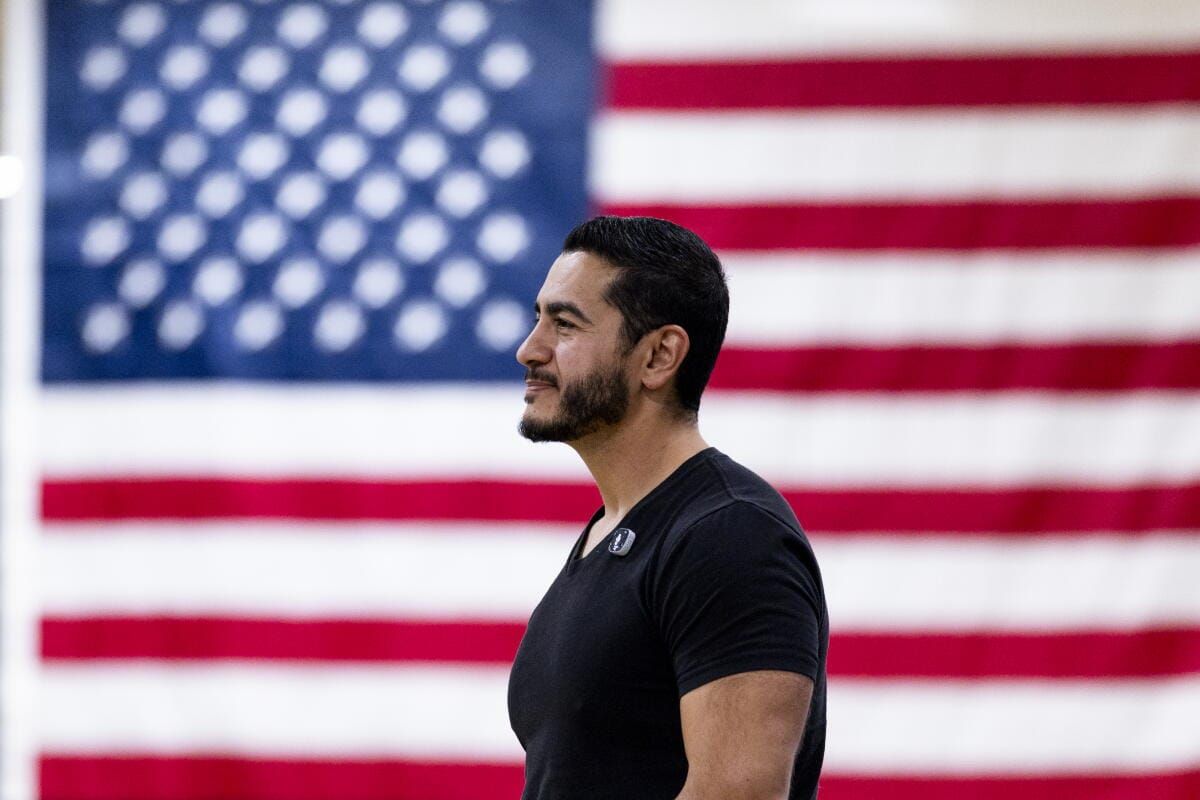
Abdul El Sayed gave a very good answer to a very bad faith question the other day, and I've been turning it over in my mind ever since. You've probably seen it, but if not go watch and come back.
As you can see, the questioner is a young fellow with the distinct appearance of a Team America World Police marionette, who identified himself (under pressure from El Sayed) as "Tommy." Tommy had something to say to the Rhodes Scholar, medical doctor, and public servant, who happens to be a Muslim U.S. Citizen of Egyptian descent, and who also happens to be Michigan's Democratic candidate for the Senate. Tommy wanted to know whether or not the candidate—again, a Rhodes Scholar, medical doctor, public servant, and U.S. citizen who happens to be a Muslim—would disavow the Muslim Brotherhood.
The venue Tommy chose for this stunt was a town hall. A town hall is a public forum; an opportunity for the public to meet this person who is asking them to vest in him an extraordinary amount of public trust, so they can ask him questions and hear his answers and see if they do indeed want to trust him. This seems like a very appropriate thing for a Senate candidate to do, and this seemed to be a well-attended town hall, and from the general tenor of the crowd it seems that El Sayed has convinced a fair number of them to bestow their portion of the public trust to him.
Tommy was there posing as a concerned Michigan citizen who wanted to understand something about this candidate by asking questions, but Tommy, it turns out, is as phony as a televangelist's capped teeth. "Tommy" is Thomas Teepell, a Republican operative out of Kansas who used to work as a staffer for Senator Josh Hawley, and he was not there to understand anything. His question wasn't even a question; it was a demand, presented as a loyalty test, predicated on El Sayed's Muslim faith and a generalized assumption that Islamophobic bigotry is normal and good.
A few definitions are in order, I think. The "Muslim Brotherhood" is a pan-Islamist and social movement founded in Egypt in 1928, which has engaged in political advocacy and has elected world leaders. They are a decentralized movement, with varying goals and tactics in varying places, so they are, like Libya (a country in which they operate), a land of contrasts. They were designated a terrorist operation last year by Donald Trump, and you could easily research to learn to what extent this attribution is deserved if you wanted to argue it point by point, and certainly you should do the research and maybe you should even make such an argument ... but even if the "terrorist" designation is totally deserved, it does seem pretty rich coming from the U.S. president, who is currently the world's biggest terrorist; a man who murdered 123 schoolchildren in a bombing in Iran this year, a man who has killed over 6,000 Iranians with bombs this year, a man who this year made credible threats to murder every person in Iran with bombs.
And a "staffer" is somebody who is on the staff of a politician/lawmaker, so a "Josh Hawley Staffer" is a staffer for Josh Hawley. And "Josh Hawley" is a thin squirrel of a man who, among other things, participated in a conspiracy and insurrection to overthrow the government of the United States, and could be seen boldly saluting the insurrectionists a few hours before they tried to murder Congress, and could also be spotted boldly fleeing the insurrectionists once the murders got started, but who nevertheless never stopped supporting the attempt to overthrow the U.S. government and install a fascist autocracy.
An "operative" is somebody who operates on behalf of an institution or organization, so a "Republican operative" is somebody who operates on behalf of the Republican Party.
And "Republicans" are America's fascist confederate anti-democracy Nazi party, a gang of self-dealing pro-rape pedophiles and pedophile-protectors and puppy pounders, who claim they are operating in the name of freedom and democracy even as they send masked goons into our streets to kidnap and murder and terrorize, who claim that they are acting to ensure peace even as they wage illegal wars, who claim they protect women and children from predators even as they join together in rigid solidary to protect their leader. This leader is a war criminal, an adjudicated rapist, a key figure in history's most notorious child rape ring, a manifestly corrupt and treacherous fool, and also the president of the United States—who just this week defended the use a vile and disgusting political ad that took the side of a child rapist and called the victim a liar.
And "Kansas" is a state in the United States that is not Michigan, which I note not because I don't think that people from Kansas can go to Michigan and ask questions at a town hall, but because a common Republican unfounded claim is that their opponents send outside agitators to influence political outcomes, which is pretty rich stuff, considering the fact of Tommy, or the fact that Tommy is not the first Tommy or even the hundredth to have made the news by doing exactly the sort of thing that this nation's army of Tommys insist is out of bounds and nefarious electioneering.
The Republican knock on the Muslim Brotherhood (and, by implication, on all Muslims) is that the Brotherhood seeks to force their religion on all others; that they define their religion as inextricably tied to autocratic domination and illiberal bigotries; that they are hostile to LGBTQ people and seek to deny women equal rights; that they advocate violence and suppression in pursuit of these goals. Again, anyone who wants to can easily search and find out to what extent this is true and isn't true as pertains to different factions that operate under the Muslim Brotherhood umbrella, but even if it were all 100% true and applicable, wow hot-doggity is this vein of critique rich to hear coming from Republicans.
Anyway, that's what Tommy was getting at with his not-question question. He was saying Abdul El Sayed isn't one of us—not a real U.S. citizen, not somebody who truly shares our values. Unlike the rest of us, whose opposition to what the Muslim Brotherhood is meant to evoke in the hearts and minds of American white people can be assumed, El Sayed will have to disavow it, and even if he does disavow it (he did) the disavowal will not be believed or accepted or even acknowledged (it wasn't and it wasn't and it wasn't), because the point was never securing the disavowal; the point was passing the bigoted smear into common currency.
By asking his not-question question, Tommy was participating in the Republican white supremacist Christian nationalist ethnic cleansing cultural project, which can be expressed by a saying popular among Republicans and other types of blood-and-soil Nazis, festooned on their campaign signs and literature, peppered into their television ads and speeches: "We're taking our country back."
And El Sayed called him on it.
It's not the end of the essay! It's only a quick reminder that The Reframe is me, A.R. Moxon, an independent writer. Some readers voluntarily support my work with a paid subscription. They pay what they want—as little as $1/month, which is more than the nothing they have to pay. It really helps.
If you'd like to be a patron of my work, there's a Founding Member level that comes with a free signed copy of one of my books and thanks by name in the acknowledgement section of my upcoming book.
Much like the phrase "will you disavow the Muslim Brotherhood," the phrase "we're taking our country back" is an interesting one for its implications. It presupposes 1) there is a group collectively understood as "we"; 2) this group once had possession of the United States; 3) this group no longer has possession of the United States; 4) because it was taken away by another group; and 5) it must be taken back.
This is all interesting stuff for sure, especially when one considers that the "we" implicit in the phrase is, if you interrogate it long enough, white people—specifically white Christian people, specifically white Christian men, specifically wealthy white Christian men. Especially when one considers that this group, as a matter of political and institutional reality, is the most over-represented, over-coddled, over-defended, and over-privileged group in the nation, maybe in human history. Especially when one considers that white people, as a matter of literal ownership, owns more of the property than any other group by a vast margin. (96% of the owners, 97% of the value, and 98% of the acres). Especially when one considers that the way mostly wealthy mostly white mostly Christian mostly men came into this possession, as a matter of historical fact, was by taking it away from others. Especially when one considers that the way wealthy white Christian men created generational wealth from this ownership was by stealing people and forcing them to provide generational free labor. Especially when one considers that what Republicans propose is not taking something back for themselves (they already have most of it), but by taking any small portion of any thing to which others lay claim (property, jobs, social inclusion, basic human rights, freedom to exist, and any protections or consideration under the long safeguarding these things) away from them.
So the group that has already taken almost everything objects to the fact that they don't have it all, and they present their grievance in terms of having something taken from them. The most included people in the country is using any small inclusion of any others as proof that they have been excluded, and as justification for re-excluding all others, which they present as a restoration of their inclusion and a reclamation of their birthright, which is something they stole in the first place.
This is what makes El Sayed's response, in my estimation, so brilliant and (I suspect) effective at persuasion.
Tommy, who was pretending to be something he is not, was accusing El Sayed of pretending to be something he is not. Tommy, who does not respect the right to freedom of religion for others, was accusing El Sayed of not respecting the right to freedom of religion for others. Tommy, who has loyalties to religious ideologies that he deems higher than the American Constitution and who seeks to impose those ideologies upon the laws of this country, was accusing El Sayed of having such dual loyalties and such goals. Tommy, who seeks to exclude all people not like himself from public life, was accusing El Sayed of wanting to exclude people like himself from public life. Tommy, who belongs to the terrorist organization currently in control of all three branches of our government, was accusing El Sayed of trying to access the controls of our government while affiliated with an organization who have been deemed terrorists.
And El Sayed exposed this mendacity, point by point, for anyone who has the capacity to observe.
He began by demanding openness. If Tommy wasn't going to identify himself, even nominally, then Tommy would get no answer. This allowed El Sayed to establish a dialogue directly between himself and his interlocutor. To this "us-and-them" topic, El Sayed imposed a "you-and-me" frame, which allowed him to draw clear distinctions; to speak to (and about) the individual Tommy, and then pivot in order to speak to the larger conversation happening between him and the people in the room, and even the larger conversation (El Sayed clearly understands that what he says will potentially be broadcast nationally) happening across the country. To speak to the "us," in other words.
Next, he made his disavowal—quickly, but clearly. I have some reservations here, insofar that I dislike accepting any part of a fascist's framing, and this was a sop to the idea that El Sayed should have to disavow the Muslim Brotherhood. However, I also perceive the rhetorical advantages that this tactic unlocked, especially by doing it offhand, treating it as if it were not the true issue at hand, which, as he went on to prove, it was not.
El Sayed then asked his own questions. He assumed nothing of Tommy without first getting Tommy to agree with each premise about himself. Yes, Tommy is implying that El Sayed has dual loyalty. Yes, Tommy thinks he hasn't heard El Sayed disavow the Muslim Brotherhood, even though the entire room just heard him do so. No, Tommy does not ask his friends and family to disavow the Muslim Brotherhood. No, Tommy does not want to explain why this would be.
Next, El Sayed directly and immediately named the true thing that Tommy would not admit, which is that Tommy's question is a fundamentally bigoted one. El Sayed dug up the buried implication of Tommy's question, held it up for all to examine, and then, one shovelful after another, question by question, buried Tommy in the hole left behind. He named the historical nature of this bigotry, and then established Tommy as an inheritor of that bigotry. More questions and answers followed. No, Tommy is not familiar with the history of the bigotry within which he operates. Yes, Tommy is a Christian. No, Tommy will not disavow attempts to codify his religious beliefs into the laws of the country.
El Sayed then established the attempt to codify any religious beliefs into law as something that is fundamentally, historically un-American—something outside of the us that is the U.S., and then offered an alternative us, one that would not exclude anyone willing to live in a country that does not exclude, and one that would not impose religious beliefs on anyone else, not even on strange and bigoted Christian extremist zealots like Tommy who would do well to choose better beliefs. In response to Tommy's world of exclusion, El Sayed spoke of a world of solidarity with all humans simply because they are human, and exposed Tommy as somebody who had, by his own choice, excluded himself from that.
El Sayed might have also established Tommy's beliefs and intentions as something that is fundamentally, historically un-Christian—something outside the us that is Christianity, but as he is not a Christian, he did not do this, which I think was wise.
Now: If you are like me, you might be thinking, "Tommy actually does represent the United States, as a matter of historical fact, because the United States has been a white supremacist nation even before its founding. You might be thinking, Tommy actually does represent Christianity, because Christianity has been the sharp point of the colonial spear and a handmaiden of autocratic imperial power for millennia."
I agree with that. I think those are true things, and I think they ought to be spoken aloud, and accepted, so they can be grappled with. I think that before we can truly heal from this historical trauma and become people who fix what is broken, we will have to confront and wrestle with this truth.
Why, then, do I approve of El Sayed's answer?
Because it also speaks to a truth—a truth of what should be. It points to a destination we should all hope for: To become a people that does not seek to exclude anyone, does not seek to control anyone; a people of solidarity who believe in universal human rights for all without any thought to what is deserved. This is not the easiest truth, but it is an an easier truth to hear than the truth of what we are and have been. It is my belief that people often need to learn easier truths before they are willing or sometimes even capable of confronting harder ones, and El Sayed is in a position and a context to speak with all his considerable skill to a great many people who have yet to confront and wrestle even with the easier truths.
What people are these? Hey, I'm glad you asked.
Or don't subscribe. I'm not the boss of you. But if you do subscribe, you get one of these essays pretty much every week.
Maybe you've noticed how I've made sure in this essay to point out how the Republicans are themselves guilty of everything they say they're against. And maybe you've thought "no duh, noted author of fiction and essay A.R. Moxon, we know this already. We've known this for 50 years. Are you surprised?"
To which I say good for you for knowing it, slappy, and congratulations for not being surprised. I know it, too, and no, I'm not surprised. But I do note it, and I have a reason.
There's a precision to the mendacity of Republicans and conservatives, writ large. Every accusation, it seems, inevitably reveals itself as a confession ... but it is so precise, so exact, detail to detail, phrase to phrase. To give just one recent example, here's what vice president and Orson Welles Care Bear JD Vance said the other day in Michigan about El Sayed.
"But if you look at his politics, if you look at his policy, it is all about saying 'this group of people is good, this ethnicity is bad, and I'm going to fight to give from the bad group of people to the good group of people."
Again, this is JD Vance, who is a big fan of that pro-rape advertisement airing in his home state of Ohio. He's also an advocate of the murderous DOGE sabotage project, and of billionaire tax breaks; he's a proponent of ICE raids, a promoter of the racist Somalia "eating the pets" blood libel and multifarious other instances of gutter racism, an active adherent to and super-spreader of the vile antisemitic "replacement" myth. This is who is saying this about El Sayed, even though El Sayed has made it quite clear he stands for universal healthcare and human rights for all. Vance may as well be saying it about himself. It describes Republican politics so perfectly, so succinctly, so accurately.
And you'll hear this sort of thing all over the country. Attacks on democracy in the name of defending elections. Summary executions by unidentified death squads in the name of safety, open corruption in the name of fairness, obstruction in the name of justice, oppression in the name of liberty, and on and on and on and on.
It's my belief that a lot of of this stuff represents calculated and deliberate tactics by people with malicious intent and a vested interest in the status quo. It's the standard bully's claim that you're hitting yourself. It's the narcissist's typical DARVO ploy. Its the reason hypocrisy is a virtue to fascists, because the point of being in the dominant in-group is that you dominate, and holding others to standards from which you excuse yourself demonstrates domination like little else can. So yes, I think we're dealing with a lot of deliberately bad-faith malicious people like Tommy.
But I also suspect there's something buried, buried, buried deep in millions of hearts and minds. A truth doesn't stop being true just because somebody is unaware of it. Even if one has buried something in their mental back yard, it's still there, seeping into their groundwater. I believe these vile buried truths will always come to the surface one way or another. Accusations, resentment, conspiracy theories, contradictions—all of them will speak to the thing in some twisted and distorted way if we stay attentive to what is being said, what people are afraid of, what people are blaming others for ... it's almost always about what they have buried in their back yards.
A couple of weeks ago I wrote of the difference between being ashamed, a state of awareness that you have fallen short of perceived ideals and beliefs about yourself, or have been involved in something that falls short—and living in shame, a state of cultivated denial about that gap, which ironically enough causes a person to stop feeling shame at all; to become a shameless person.
It's my belief that we're a nation that lives in shame. I believe that living in shame is encouraged and incentivized, and so I think there are millions of people who simply do not engage with the truth of what they are involved with, or the reality of their world views, because misleading and comfortable narratives, propaganda, and disinformation make unawareness the path of least resistance. I believe there are millions more who are psychologically unable (or nearly unable) to even address such things, because encountering evidence of the truth is so confrontational to their world views that it shuts down their critical reasoning.
Here's what I know: I know that exposing the truth allows people to encounter it, and if they encounter it, they might accept it, if they have a mind open to it. If it's not exposed, I don't think they'll encounter it. I don't know any way to get somebody to accept truth by keeping it hidden. If you have one, let me know.
I know that we live in a country where saying the true thing is usually presented as rude, uncouth, disruptive, divisive, confrontational—far more so, more often than not, than is the lie. That's the narrative, and it's scripts are broadcast on our platforms of influence whenever somebody digs up the buried thing and inspects it for all to see.
I think it would be good if we disrupted that narrative by speaking the buried truths; by uncovering what lies beneath—the fear, the hatred, the bad priorities—so you can explain why this isn't something you cannot support, why the rationale is something that you don't fall for, and why you don't think it's who any we ought to be. I would follow El Sayed's example, by starting with the context of "I" and "me" before tying it to an ever-expanding, non-exclusionary "us."
Will this convince people? Certainly not all. Some people are very aware of their abuses, committed to their malice, and ruthless in seeking their advantages, and we should become perceptive about recognizing such people and skilled at exposing them. Others are too committed to living in the shame of supremacy and exceptionalism to encounter truth even when it is given to them—shame, because the reality is that they are not supreme, they are not exceptional, they are simply what all of us are, which is human beings, and that is enough. For those who are not convinced, we will have to move on toward a universal human brotherhood without their help or permission ... at least until they are ready to encounter the truth they've buried, grapple with it, and decide to leave their lives of shame, improve and grow.
But some? Yes, I think some will be ready for truth. So I believe that naming the true thing will be convincing for some, and some is more than none.
Let's get some today. There will be more to get tomorrow.
Republicans, billionaires, white Christian nationalists, and other fascists and autocrats want to take back their country—which they already mostly own, and they want to do it by defining "us: to mean "them," and only them.
Let's dig up the truths they've buried. Let's examine them, and then, shovel by shovel, let's bury their lies in the hole left behind.
Let's speak to a truth—a truth of what should be. Let's point to a destination we should all hope for. Let's insist on becoming a people who does not seek to exclude anyone, who does not seek to control anyone; a people of solidarity who believe in universal human rights for all without any thought to what is deserved.
If we do that, we'll be reclaiming something that has been taken from us—not just the country itself, but what it means to say "our."
That's how we take our country back.
The Reframe is totally free, supported voluntarily by its readership.
If you liked what you read, and only if you can afford to, please consider becoming a paid sponsor for as little as $1/month. If you'd like to be a patron of my work, there's a Founding Member level that comes with a free signed copy of one of my books, and thanks by name in the acknowledgement section of any book I publish while you are a member.
Looking for a tip jar but don't want to subscribe?
Venmo is here and Paypal is here.
A.R. Moxon is the author of the novel The Revisionaries (2019) and the essay collections Very Fine People (2024) and Fighting in the Dark (2026), which are available in most of the usual places, and some of the unusual places. You can get his books right here for example. He trying to find a way to, but there's nothing he can say to make it stop.